
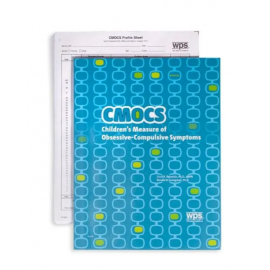
(CMOCS) Children's Measure of Obsessive-Compulsive Symptoms

(CMOCS) Children's Measure of Obsessive-Compulsive Symptoms

SGD$0.00
Brand:
Product Code: W-468X
Availability: 100
Viewed 20 times

Available Options

Product Description

(CMOCS) Children's Measure of Obsessive-Compulsive Symptoms

Benefit

Provides a psychometrically sound measure of obsessions, compulsions, and their impact on daily functioning–anchored in DSM-IV criteria for OCD


Norms

Based on a nationally representative sample of 1,644 children and adolescents


Scores

Standard scores, percentiles, and descriptive categories (Below Average, Average, High, or Extremely High)


Format

Self-report


Admin Time

10-15 minutes


Ages

8 to 19 years


Publish Date

2010


Qualifications

Level C required.


Obsessive–Compulsive Disorder (OCD) is relatively common in children and teens, and its impact on daily functioning can be severe. Yet until now it has been difficult to assess—those who suffer from OCD tend to hide their symptoms; comorbid conditions often obscure its presence; and existing OCD instruments have been limited by inadequate normative and psychometric data.

A Self-Report Measure That’s Brief, Easy to Use, and Well Normed
Now there’s a new option for evaluating OCD—a brief, easy-to-administer, self-report inventory that offers both detailed and summary scores, all referenced to a large, representative norm sample. The new Children’s Measure of Obsessive–Compulsive Symptoms (CMOCS) assesses and quantifies the subjective experience of children and teens who have obsessions and/or compulsions at either a clinical or subclinical level.

The CMOCS is composed of 56 items covering six Problem Areas:

- Fear of Contamination
- Rituals
- Intrusive Thoughts
- Checking
- Fear of Mistakes and Harm
- Picking/Slowing
These scales address obsessions and compulsions and their impact on daily functioning. In addition, two validity scales alert you to inconsistent responding or defensiveness on the examinee’s part.

Problem Area Scores and Summary Scores Reflecting Severity and Impact
Group or individually administered in just 10 to 15 minutes, the CMOCS employs a simple self-report format with a 4-point response scale ranging from “Never” to “Almost Always.” Items are written at a second-grade reading level.

The test generates six Problem Area Scores plus two Summary Scores: the Total Score, indicating overall symptom level, and the Impact Score, reflecting the degree to which obsessions or compulsions interfere with daily functioning and cause distress. Both are strongly associated with clinical status.

Useful in Virtually Any Assessment Setting
Because it gives you both the big picture and a profile of specific obsessions and compulsions, the CMOCS is useful for various assessment purposes.

- In clinical settings the test is a helpful diagnostic tool. Its items are anchored in DSM-IV criteria for OCD; its norm-referenced scores help you determine whether symptoms are clinically significant; its rich, detailed score profile guides intervention planning; and its brevity simplifies symptom monitoring.
- In school settings CMOCS results, particularly the Impact Score, can help you ascertain whether students meet IDEA criteria for Emotional Disturbance. They’re also useful in creating IEPs, determining whether misbehavior is a direct result of a student’s disability, and measuring response to intervention.
- In research settings the CMOCS can be used to establish baseline data, compare individual children or large groups, and identify subgroups. Its strong normative sample and easy reading level make the test ideal for research applications.

The CMOCS answers the need for a psychometrically sound self-report measure of problematic obsessions and compulsions experienced by children and adolescents. The fact that it can be interpreted at both summary and specific levels makes this unique test widely useful.

W-468CMOCS KitEmail for quotation
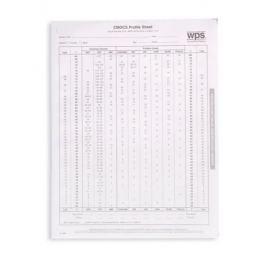
W-468ACMOCS AutoScore Form (Pack of 25)Email for quotation
W-468BCMOCS ManualEmail for quotation


When you order from google.com, you will receive a confirmation email. Once your order is shipped, you will be emailed the tracking information for your order's shipment. You can choose your preferred shipping method on the Order Information page during the checkout process.

The total time it takes to receive your order is shown below:

img

The total delivery time is calculated from the time your order is placed until the time it is delivered to you. Total delivery time is broken down into processing time and shipping time.

Processing time: The time it takes to prepare your item(s) to ship from our warehouse. This includes preparing your items, performing quality checks, and packing for shipment.

Shipping time: The time for your item(s) to tarvel from our warehouse to your destination.

Shipping from your local warehouse is significantly faster. Some charges may apply.

In addition, the transit time depends on where you're located and where your package comes from. If you want to know more information, please contact the customer service. We will settle your problem as soon as possible. Enjoy shopping!